


Why Leno’s Law Matters for Classic BMW Owners and Enthusiasts
Legal Disclaimer: This content is provided for informational purposes and should not be relied upon as legal advice or a guarantee of vehicle exemption status. Eligibility under California’s Leno’s Law depends on specific collector vehicle qualifications and applicable regulations, which may change as the law is implemented. For authoritative information on Smog Check exemptions, refer to California’s Bureau of Automotive Repair.
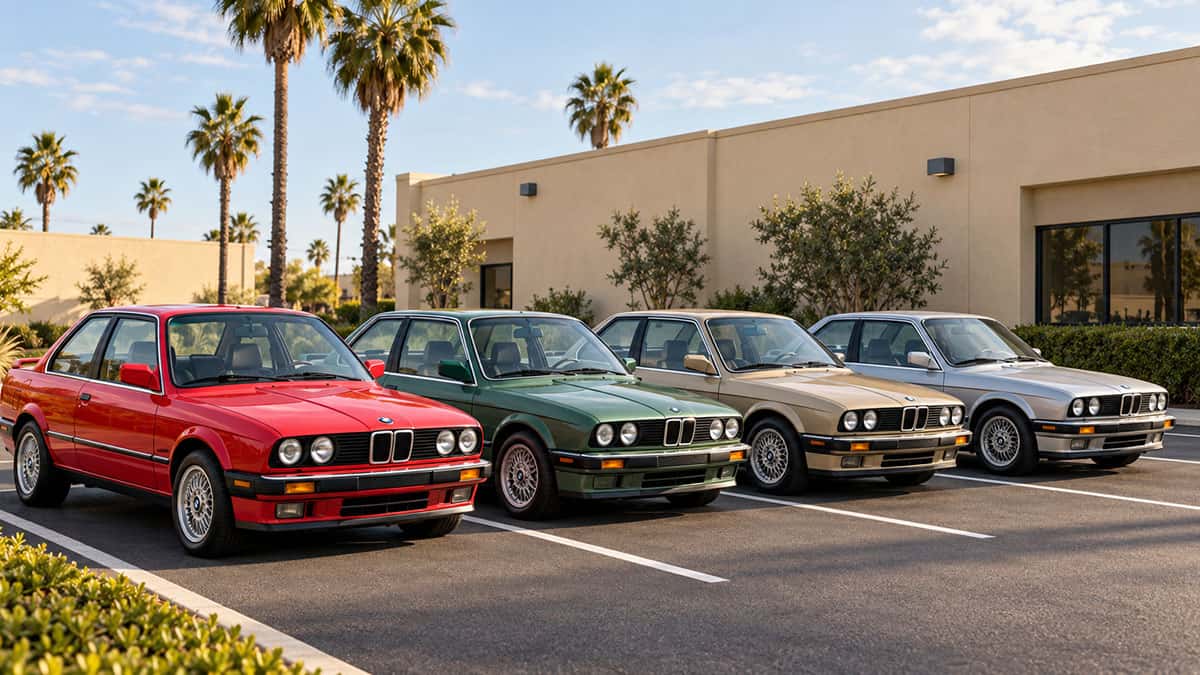
Quick answer: Leno’s Law, officially SB 1392, creates a new Smog Check exemption for certain collector vehicles from model years 1976 through 1985. That covers several important BMW generations, from the E21 3 Series and E12 5 Series to the E24 6 Series and early E30s.
What Is Leno’s Law?
Named for former Tonight Show host and automotive collector Jay Leno, the legislation grew out of efforts to recognize and preserve California’s classic car heritage. Leno joined the Specialty Equipment Market Association (SEMA) in supporting the measure, and Governor Gavin Newsom signed it into law at Leno’s garage in Burbank on September 16, 2026.
Officially known as California Senate Bill 1392, the law acknowledges that vehicles maintained as collectibles serve a different purpose than those driven daily. It offers a limited exception to California’s longstanding emissions inspection requirements while retaining protections intended to preserve air quality.
Why Leno’s Law Matters to BMW Collectors
BMW built some memorable cars between 1976 and 1985, and many of them have long since moved from used-car territory into enthusiast and collector ownership.
California’s Smog Check rules have remained in place for those cars because vehicles from 1976 onward generally stayed within the program. Leno’s Law creates a new path for qualifying collector vehicles from this period to become exempt.
For BMW enthusiasts, that makes an already interesting stretch of the brand’s history worth another look.
How the New Smog Exemption Will Work
Under Leno’s Law, the new classic BMW smog exemption begins with qualifying vehicles from the oldest eligible model years in 2028 and expands annually through 2033.
Starting January 1, 2028, qualifying collector vehicles from model years 1976 through 1980 can begin receiving the exemption.
After that, one additional model year is added each year:
- 2029: 1981 models
- 2030: 1982 models
- 2031: 1983 models
- 2032: 1984 models
- 2033: 1985 models
The law applies to collector vehicles, not cars used for everyday transportation.
A qualifying vehicle must meet California’s definition of a collector motor vehicle and be used mainly for things like shows, exhibitions, parades, or similar limited use.
There are also different ways an eligible vehicle can qualify. Collector vehicle insurance is one path. Beginning in 2030, certain vehicles driven fewer than 1,000 miles per year can also use a low-mileage path.
California’s Bureau of Automotive Repair is still working through parts of the implementation process, so owners should check the final requirements before assuming a car is exempt.
BMWs From 1976 to 1985 That Deserve Another Look
For enthusiasts researching “BMW classic cars California,” the model years covered by Leno’s Law offer plenty to explore. This period includes the first 3 Series, the original 6 Series, two generations of the 5 Series, the M1, and the beginning of the E30 era.
Here are a few of the cars that make this particular 10-year window so interesting.
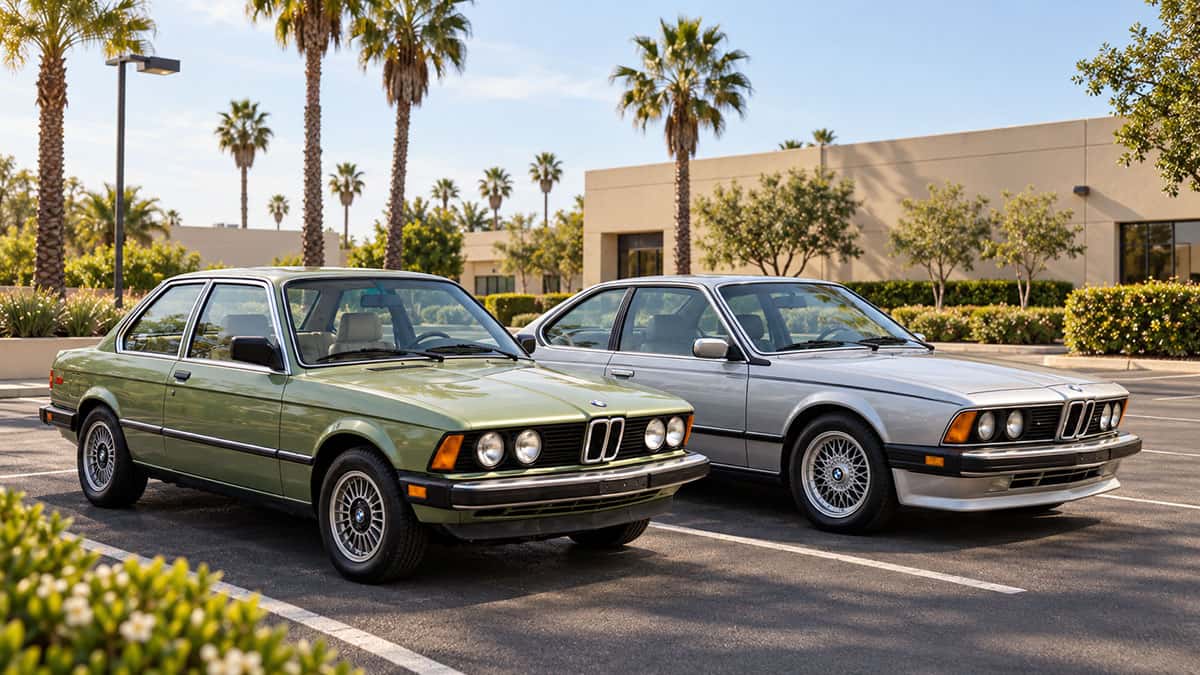
BMW 3 Series E21
The E21 is where the 3 Series story starts. It is compact, straightforward, and far more analog than anything wearing a 3 Series badge today.
It also sits in an interesting spot for collectors. It carries a lot of the character people like about earlier BMWs without being another 2002. For someone interested in the roots of the 3 Series, it is hard to ignore.
BMW 6 Series E24
You don’t need to know the chassis code to recognize an E24. The long hood, low roof, and shark-nose front end gave the original 6 Series one of the era’s most distinctive BMW shapes. Early examples fall squarely within the years covered by Leno’s Law, giving California collectors another reason to pay attention.
BMW 5 Series E12 and E28
The E12 and E28 show two very different sides of the 5 Series.
The E12 still feels like an old-school BMW, with thin pillars, simple controls, and clean body lines. The E28 feels more familiar to anyone who grew up around 1980s BMWs and marks the point where the 5 Series settled into a formula that would carry forward for years.
Both generations have plenty of enthusiast appeal, and both fall within the model years covered by Leno’s Law.
BMW M1
The M1 is the outlier here. It is mid-engine, hand-built, rare, and completely different from the sedans and coupes BMW was known for at the time. It was also the first car BMW Motorsport developed from the ground up.
Most people are not casually shopping for one, but every M1 production year falls inside the Leno’s Law range.
Early BMW E30 3 Series
The E30 is probably the chassis most BMW enthusiasts will recognize instantly.
The earliest U.S. cars from 1984 and 1985 fall into the final years covered by Leno’s Law. They have the boxy proportions, simple interiors, and mechanical feel that made the E30 such a favorite in the first place.
Those model years will not reach potential eligibility until 2032 and 2033, but they are already firmly in collector territory.
A Different Reason to Revisit This Era of BMW
Leno’s Law won’t suddenly turn every E21 or E24 into a collector car. BMW enthusiasts were interested in these cars long before the law changed. However, the new California classic car smog exemption gives qualifying owners another reason to appreciate and preserve these vehicles.
It can remove one hurdle for qualifying California-owned examples as the exemption takes effect. For someone already considering an older BMW, that makes the 1976 to 1985 window a little more interesting than it was before.
At BMW of El Cajon, we spend every day around the brand and the cars that keep it moving forward. The technology and lineup look very different today, but a clear connection remains between cars like the original 3 Series and 6 Series and the BMWs people come to see in our showroom now.
FAQs About Leno’s Law and Classic BMWs
Does Leno’s Law apply to 1986 and newer BMWs?
No. The current law stops with the 1985 model year. A 1986 BMW will not automatically become exempt later just because it reaches the same age as an eligible 1985 car.
Can a modified BMW qualify under Leno’s Law?
Possibly, but a Smog Check exemption does not automatically make every engine or emissions modification legal. Owners should check the applicable California and federal rules before making emissions-related changes.
When can a 1984 or 1985 BMW qualify?
1984 vehicles can begin qualifying in 2032. Qualifying 1985 vehicles follow in 2033.
Does a Smog Check exemption mean I can remove emissions equipment?
No. An exemption from regular Smog Check requirements is not permission to remove emissions equipment. Other state or federal rules may still apply.
Where can BMW owners find classic car smog exemption California requirements?
BMW owners can consult the California Bureau of Automotive Repair for eligibility requirements, application procedures, and updates on implementing Leno’s Law. BAR remains the official source for determining how qualifying collector vehicles can obtain the exemption.
Information Current as of October 2026: The Smog Check exemptions established under Leno’s Law are scheduled to begin in 2028, with additional model years becoming eligible through 2033. California is still finalizing the qualification and verification procedures. Vehicle owners should review the latest guidance from the California Bureau of Automotive Repair before deciding how to proceed under the new exemption.
0 comment(s) so far on Why Leno’s Law Matters for Classic BMW Owners and Enthusiasts