


BMW SUV Cargo Space Comparison: Which Model Fits Your Life?
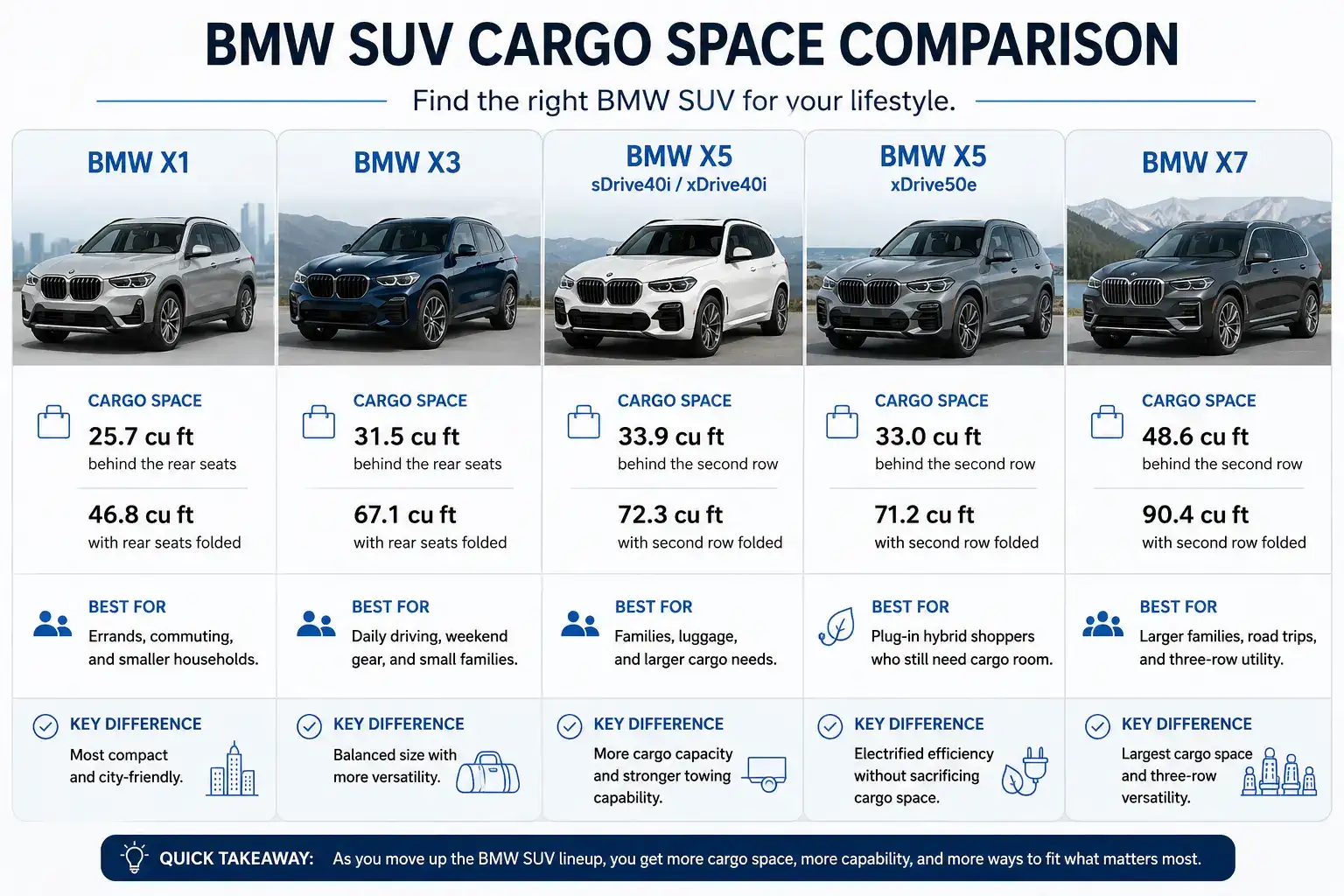
 Quick Answer: BMW SUV cargo space varies by model, seating layout, and powertrain, so the best choice depends on how you use the vehicle every day. BMW lists the X1 with about 25.7 cubic feet behind the rear seats, the X3 with 31.5 cubic feet, the X5 40i with 33.9 cubic feet, and the X7 with 48.6 cubic feet behind the second row. For San Diego drivers comparing errands, school routines, airport runs, pets, and weekend gear, the right BMW SUV is the one that fits your cargo needs without feeling oversized for daily driving.
Which BMW SUV Has the Most Cargo Space?
The BMW X7 has the most cargo space among BMW’s core SUV lineup. BMW lists the X7 with 48.6 cubic feet of cargo capacity with the second row upright, expanding to 90.4 cubic feet with the second row folded.
The X7 is the strongest fit when your cargo needs overlap with passenger needs, such as larger families, carpooling, travel sports, or long road trips with both people and luggage aboard. The tradeoff is size, so drivers who spend more time in tight parking may prefer a smaller model.
The X5 is the next-strongest option, offering generous cargo space in a more manageable midsize package.
How Much Cargo Space Do BMW SUVs Offer?
BMW SUV cargo space ranges from compact daily use in the X1 to larger family and travel capacity in the X7.
- BMW X1: About 25.7 cu ft behind the rear seats, expanding to roughly 46.8 cu ft folded. Best for errands, commuting, and smaller households.
- BMW X3: 31.5 cu ft behind the rear seats, expanding to 67.1 cu ft folded. Best for daily driving, weekend gear, and small families.
- BMW X5 sDrive40i and xDrive40i: 33.9 cu ft behind the second row, expanding to 72.3 cu ft when folded. Best for families, luggage, and larger cargo needs.
- BMW X5 xDrive50e: 33.0 cu ft behind the second row, expanding to 71.2 cu ft folded. Best for plug-in hybrid shoppers who still need cargo room.
- BMW X7: 48.6 cu ft behind the second row, expanding to 90.4 cu ft folded. Best for larger families, road trips, and three-row utility.
Is the BMW X1 or X3 Enough Cargo Space for Daily Driving?
The BMW X1 or X3 can provide enough cargo space if your daily routine centers on commuting, errands, groceries, pets, and occasional weekend bags. These models make the most sense for drivers who want useful SUV space while keeping the vehicle easier to park and maneuver.
The X3 gives shoppers a step up in space and presence. BMW lists the 2026 X3 with 31.5 cubic feet of cargo capacity behind the rear seats, which can make a meaningful difference for weekend gear, school bags, luggage, and daily family use.
Why Do Many San Diego Drivers Step Up to the BMW X5?
Many San Diego drivers step up to the BMW X5 because it offers more usable cargo space without moving into BMW’s largest SUV, with 33.9 cubic feet behind the second row and 72.3 cubic feet with the second row folded. That added space helps during airport runs, family weekends, sports schedules, and home projects, and the split tailgate makes loading heavier items easier.
The X5 also lets you pair cargo room with plug-in hybrid flexibility, since the xDrive50e gives up only a little space to its battery. If you are weighing sizes for family use, our guide to the best BMW SUV for families goes deeper.
Do BMW Plug-In Hybrid or Electric SUVs Have Less Cargo Space?
Yes, battery placement can slightly reduce cargo space in a plug-in hybrid. The BMW X5 xDrive50e is the clearest example, listed at 33.0 cubic feet behind the rear seats and 71.2 folded, just below the 40i models, a difference small enough that it may not matter for daily use.
The best approach is to compare the exact model and configuration you are considering, since a plug-in hybrid, a coupe-style SUV like the X6, or a three-row SUV can all use cargo space differently.
Where Can You Compare BMW SUV Cargo Space Near San Diego?
You can compare BMW SUV cargo space near San Diego at BMW of El Cajon, where shoppers can review new BMW SUV inventory, compare X1, X3, X5, and X7 options, explore lease and finance options, estimate a trade-in, and schedule a test drive. Seeing the cargo area in person can help you decide faster than comparing numbers alone.
Start your BMW SUV cargo space comparison with how you use the cargo area most often. The X1 and X3 work well for compact SUV shoppers; the X5 offers many families a strong middle ground; and the X7 is the better match when three rows and maximum cargo room matter most.
FAQs About BMW SUV Cargo Space
How much cargo does the BMW X7 have behind the third row?
With all three rows in use, the X7 offers considerably less cargo room behind the third row, which is why folding the third or second row matters when you carry both passengers and gear. BMW lists up to 90.4 cubic feet with the second row folded, so confirm the behind-the-third-row figure for your model year if you often travel full.
Do BMW SUV rear seats fold flat for longer items?
Most BMW SUVs use a 40/20/40 split folding rear seat, which lets you drop the center section for long items like skis or lumber while keeping the outer seats open for passengers. This flexibility often matters more than the raw cubic foot figure for how usable the cargo area feels.
Is the BMW X3 or X5 better for a growing family?
The X3 handles daily errands, school runs, and weekend gear well for smaller families, while the X5 adds a larger second row and more cargo for growing families or frequent travel. If you expect to carry more people and gear over time, the extra space in the X5 tends to age better with a family.
Is BMW SUV cargo space better than a Mercedes SUV?
It depends on the models being compared. BMW X3, X5, and X7 cargo space should be compared with direct rivals such as the Mercedes-Benz GLC, GLE, and GLS because body size, seat layout, and hybrid packaging can affect the results.
Which BMW SUV should I compare if I need three rows?
Compare the BMW X7 if you need regular three-row seating. Some shoppers may also look at specific X5 configurations, but the X7 is the stronger fit when passenger space and cargo flexibility need to work together every week.
0 comment(s) so far on BMW SUV Cargo Space Comparison: Which Model Fits Your Life?